

Basics
Meet the Home Hardening Score: A Free Five-Minute Wildfire Check for Your House
The Home Hardening Score is a free, five-minute look at how your house is built to handle embers, heat and flame. Here is what it asks, the California rules behind it and how to read your score.
September 29, 2026, 7 minute read
What the Home Hardening Score Is
The Home Hardening Score is a free self-assessment for homeowners who want to know how well their house is built to handle a wildfire. You enter your address, answer a short set of questions about your roof, vents, eaves, windows, walls, deck and the ground right next to the house, and get a score from 0 to 100. It takes about five minutes. There is no account and no cost.
It is built for homeowners in wildfire country, especially Californians, because the questions map to specific state rules. Homeowners elsewhere can use it too. Nobody visits your property. You describe your own house, and the score organizes your answers against the standards that apply to it.
What Home Hardening Means
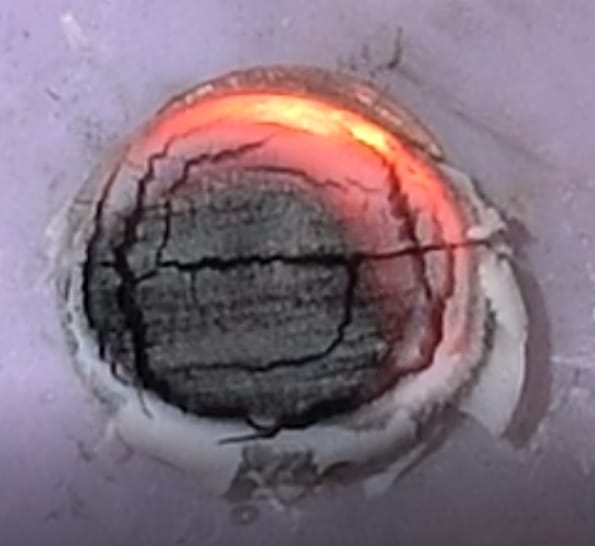
Home hardening means making the structure itself harder to ignite. A wildfire reaches a house in three ways: embers, which are burning bits of wood and vegetation carried on the wind; radiant heat from flames nearby; and direct flame contact. Hardening addresses all three at the building.
Embers matter most. NFPA's Firewise USA program says research points to embers and small flames as the main way the majority of homes ignite. IBHS has reported that as many as 90 percent of homes damaged or destroyed in wildfires were first ignited by embers or by fires the embers started.
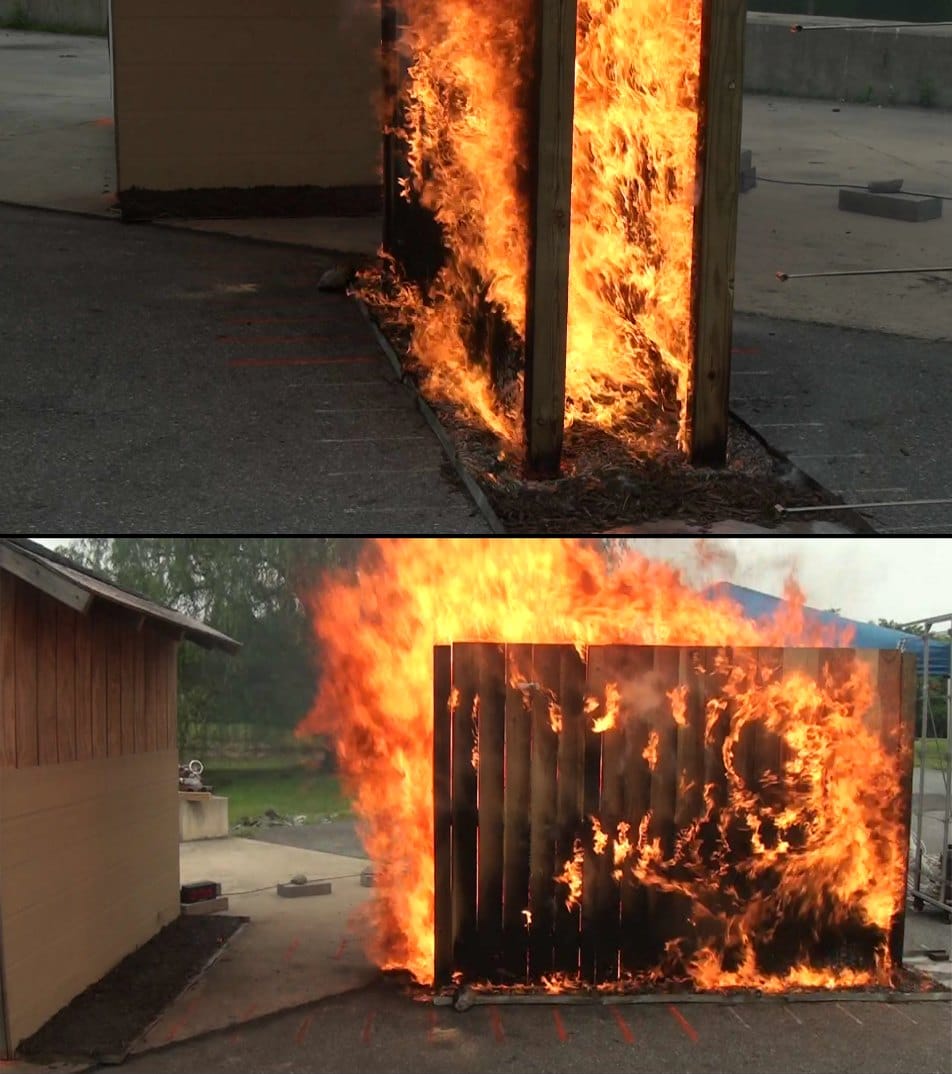
That is why small building details decide so much. All an ember needs is an opening, such as an unscreened vent, or something to land on, such as dry needles in a gutter or mulch against the siding. Close the openings and remove the fuel, and an ember has far less to work with.
What the Score Measures
The Ten Areas
The assessment walks ten parts of the house and the ground closest to it:
- Roof: the covering and its fire rating, plus flashing, gutters and debris
- Vents: attic, foundation and crawlspace openings
- Eaves and soffits: the underside of the roof overhang
- Windows: how many panes, and whether you have working shutters
- Zone 0: the first five feet of ground around the house
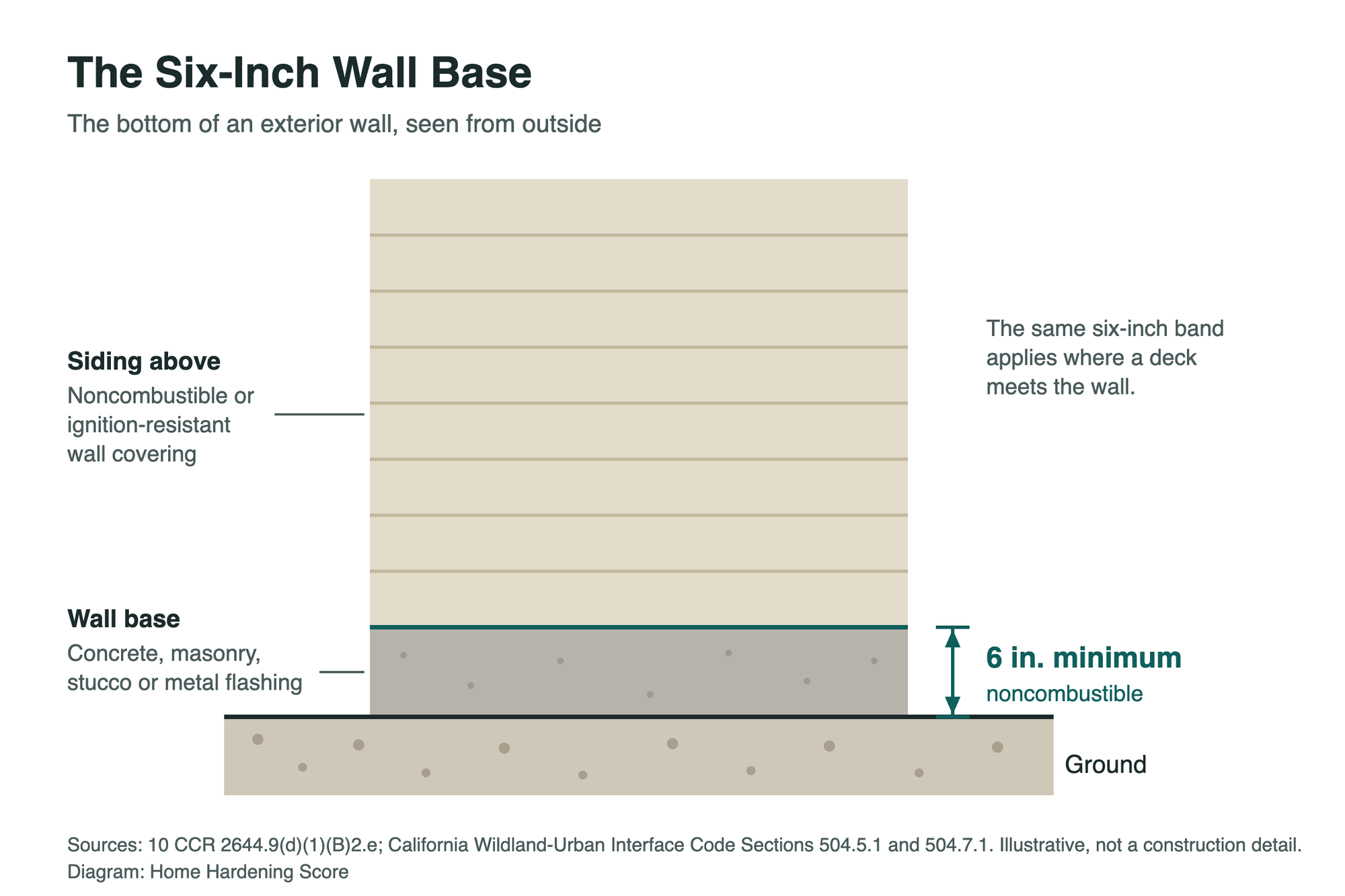
- Wall base: the bottom six inches, where the wall meets the ground
- Deck: the surface, the space underneath and the joint where it meets the wall
- Siding: the material on your exterior walls
- Fences and gates: anything combustible within five feet of the house
- Outbuildings: sheds, pergolas and playhouses within 30 feet
For the ground beyond five feet, the Defensible Space Score walks it zone by zone, out to 100 feet.
How the 0 to 100 Score Works
Your answers produce a score from 0 to 100 and a rating band. The results also track six essentials: the roof covering, eaves, vents, Zone 0, fences and gates, and the wall base. If you do not know an answer, choose "Not sure." It does not count against you, and it comes back as an open item with a hint on how to check.
The California Rules Behind the Score
The Building Code: Chapter 7A and R337
California's wildfire construction standards long lived in California Building Code Chapter 7A and California Residential Code Section R337. In the 2025 code, effective January 1, 2026, the Building Standards Commission relocated Chapter 7A, along with R337, to the new California Wildland-Urban Interface Code, Title 24, Part 7. Its Section 504 covers roofs, vents, eaves, walls, windows and decks, mainly for new construction in mapped fire hazard areas.
10 CCR 2644.9: Safer from Wildfires
Title 10, California Code of Regulations, Section 2644.9 is the regulation behind the Department of Insurance's Safer from Wildfires program. It requires an insurer's rating plan to take specific mitigation into account: five building hardening measures, five in the immediate surroundings and two community designations. Most questions in the assessment show the subdivision they come from.
PRC 4291 and AB 3074: Zone 0
Public Resources Code Section 4291 is California's defensible space law. AB 3074, signed in 2020, added an ember-resistant zone within five feet of a structure, now called Zone 0, and left the details to the Board of Forestry and Fire Protection. The Board adopted emergency Zone 0 regulations on August 19, 2026, and on September 8 the package was withdrawn from review at the Office of Administrative Law while the Board continues to work on it. As of September 28, 2026, no statewide Zone 0 regulation is in effect. Some cities have their own rules, so check with your local fire agency.
The Materials Named in Those Rules
- Class A roofing. The highest of three fire ratings for a roof covering, earned in fire tests under ASTM E108.
- Ember- and flame-resistant vents. Listed by the State Fire Marshal or tested to ASTM E2886, which measures how well a vent resists embers and direct flame.
- Enclosed eaves. A soffit that closes off the underside of the overhang, so heat and embers cannot collect against open framing.
- Multipane, tempered glass. The code calls for multipane glazing with at least one tempered pane.
- The six-inch noncombustible wall base. Noncombustible material at the bottom of the wall, where ground fire and embers collect.
- Noncombustible siding. Wall coverings such as stucco, masonry, fiber cement or metal.
- Deck materials. The code sets requirements for deck surfaces, and the assessment asks what yours is made of.
How Photos Fit
At the end you can add six photos: all four sides of the house, the roof, and one shot with the house number visible. This step is optional, and photos never add points to an answer. They let us check your answers against what the house shows and narrow the range around your score. On answers alone, the score stops at 90. A complete set of six is what lets a home reach the top of the scale.
What Your Score Means
Read the number as a readiness measure: how much of the well-documented hardening work is in place, based on what you reported. Add your email for the full report, which walks every measure and lists recommended next steps in the order they are worth doing. For the household side of readiness, the Wildfire Action Plan builds an evacuation and property checklist.
The score does not predict whether a house will survive a fire. It is not an insurance decision, and it does not guarantee coverage, a renewal, a price or a discount. Only your carrier can say what a measure means for your policy.
What We Are Working Toward
California already requires insurers that price wildfire risk to recognize qualifying mitigation measures. Our goal goes further. We are gathering the evidence to show carriers that mitigation lowers wildfire risk, and that lower risk should mean better access to coverage and lower premiums for the homes that do the work. That case has not been proven yet. Clear, verifiable records of what homeowners have done are how we intend to help build it.
Take Your Home Hardening Score
It takes about five minutes and costs nothing.
California homeowners: check your coverage with Five Bays Insurance Agency and ask how the mitigation you have done may affect your options. Five Bays Insurance Agency is a licensed California agency (Department of Insurance license 6016871) and, like the Home Hardening Score, part of AACI Group.
Sources
- "Cal. Code Regs. Tit. 10, § 2644.9, Consideration of Mitigation Factors; Wildfire Risk Models." California Department of Insurance, via Legal Information Institute. Filed October 14, 2022. https://www.law.cornell.edu/regulations/california/10-CCR-2644.9
- "Safer from Wildfires." California Department of Insurance. Undated. https://www.insurance.ca.gov/01-consumers/200-wrr/Safer-from-Wildfires.cfm
- "2025 Part 2 Chapters 5, 7, 7A and 8." California Building Standards Commission. 2025 code cycle. https://www.dgs.ca.gov/BSC/Resources/2025-Title-24-California-Code-Changes/2025-Part-2-Chapters-5--7--7A-and-8
- "2025 California Wildland-Urban Interface Code, Title 24, Part 7." California Building Standards Commission, published by the International Code Council. Effective January 1, 2026. https://codes.iccsafe.org/content/CAWUIC2025P1
- "Information Bulletin 26-004: 2025 California Building Standards Code." Office of the State Fire Marshal. April 14, 2026. https://osfm.fire.ca.gov/resources/information-bulletins
- "Public Resources Code Section 4291." California Legislative Information. Current. https://leginfo.legislature.ca.gov/faces/codes_displaySection.xhtml?lawCode=PRC§ionNum=4291
- "AB 3074, Fire prevention: wildfire risk: defensible space: ember-resistant zones." California Legislative Information. Chaptered 2020. https://leginfo.legislature.ca.gov/faces/billNavClient.xhtml?bill_id=201920200AB3074
- "Proposed Rule Packages: Zone 0 Defensible Space." California Board of Forestry and Fire Protection. August 2026. https://bof.fire.ca.gov/regulations-and-policies/proposed-rule-packages
- "Recent Actions Taken on Emergency Regulations" (OAL file 2026-0828-03E, Zone 0 Defensible Space, withdrawn). California Office of Administrative Law. September 8, 2026. https://oal.ca.gov/emergency_regulations/Recent_Actions_Taken_on_Emergency_Regulations/
- "Defensible Space Zones 0, 1 and 2." California Board of Forestry and Fire Protection. Accessed September 28, 2026. https://bof.fire.ca.gov/projects-and-programs/defensible-space-zones-0-1-and-2
- "ASTM E108, Standard Test Methods for Fire Tests of Roof Coverings." ASTM International. Active edition E108-25. https://store.astm.org/e0108-20a.html
- "ASTM E2886/E2886M-20, Standard Test Method for Evaluating the Ability of Exterior Vents to Resist the Entry of Embers and Direct Flame Impingement." ASTM International. 2020. https://store.astm.org/e2886_e2886m-20.html
- "Firewise USA." National Fire Protection Association. Accessed September 28, 2026. https://www.nfpa.org/education-and-research/wildfire/firewise-usa
- "Embers Cause Up to 90% of Home and Business Ignitions During Wildfire Events." Insurance Institute for Business and Home Safety, via PR Newswire. March 12, 2019. https://www.prnewswire.com/news-releases/embers-cause-up-to-90-of-home--business-ignitions-during-wildfire-events-300811068.html
- "NIST Study Finds Wildfire Hazards in Residential Fences and Mulch Beds." National Institute of Standards and Technology. August 11, 2022. https://www.nist.gov/news-events/news/2022/08/nist-study-finds-wildfire-hazards-residential-fences-and-mulch-beds
Next step
Run a Home Hardening Score for your address and get a written record of what is already in place.
Get My Score